Release of Amaterus AI, Bringing NEDO Project Results into Practical Use
Transition State Technology Co., Ltd.
Nara Institute of Science and Technology (NAIST)
A Program That Can Reduce Functional Chemical Development Time to Approximately One-Fifth
Launch of a Service to Select and Evaluate Optimal Routes from a Vast Range of Chemical Synthesis Pathways
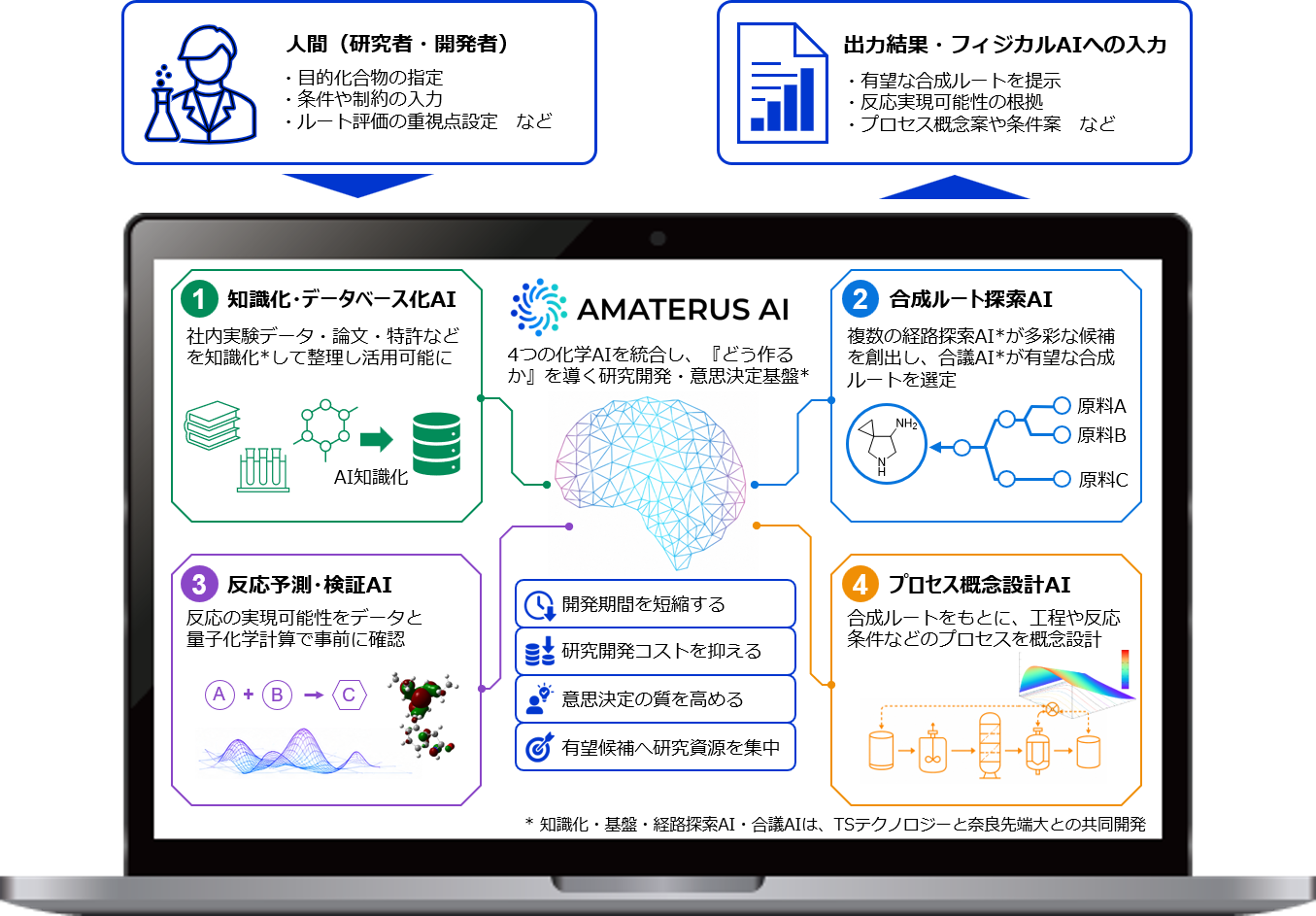
As part of NEDO’s project on the development of continuous precision production process technologies for functional chemicals (the “Project”), Transition State Technology Co., Ltd., a venture originating from Yamaguchi University, and Nara Institute of Science and Technology (NAIST) have developed AMATERUS AI (the “Program”), a chemical synthesis program that combines AI-based synthesis route design with reaction evaluation using quantum chemical calculations.
The Program can instantly select and evaluate the routes best suited to a given objective from a vast number of proposed chemical synthesis pathways generated using multiple approaches that combine AI and quantum chemical calculation technologies: (1) AI for knowledge structuring and database creation, (2) AI for synthesis route exploration, (3) AI for reaction prediction and validation, and (4) AI for conceptual process design. Using the Program can significantly reduce the time required to develop functional chemicals—to approximately one-fifth of the time required by conventional methods.
Transition State Technology will begin providing services using the Program on Wednesday, September 30, 2026.
1. Background and Results
Functional chemicals, including pharmaceuticals, agrochemicals, fragrances, and electronic materials, are high-value-added products manufactured in small quantities across a wide range of varieties. Shortening the time to commercialization and establishing stable manufacturing processes are key sources of competitiveness. However, designing synthesis routes—determining the starting materials, reactions, and conditions needed to produce a target compound—depends on literature searches, researchers’ experience, individual calculation and search tools, and experimental trial and error. In particular, the enormous number of possible synthesis routes makes identifying the optimal route costly in both time and human resources.
The Project*1 ran from fiscal year 2019 through fiscal year 2025 and comprised three research themes: (1) development of catalyst and reaction technologies, (2) development of separation and purification technologies, and (3) application of computational chemistry. From fiscal year 2022 through fiscal year 2025, Transition State Technology and its subcontractor, NAIST, worked to accelerate and improve chemical synthesis route exploration, validation of candidate synthesis routes, and simulation-based evaluation of chemical synthesis reactions. Specifically, they developed the Program*2 to instantly select and evaluate routes best suited to a given objective from a vast number of candidates proposed through multiple approaches combining AI and quantum chemical calculation technologies: (1) AI for knowledge structuring and database creation, (2) AI for synthesis route exploration, (3) AI for reaction prediction and validation, and (4) AI for conceptual process design.
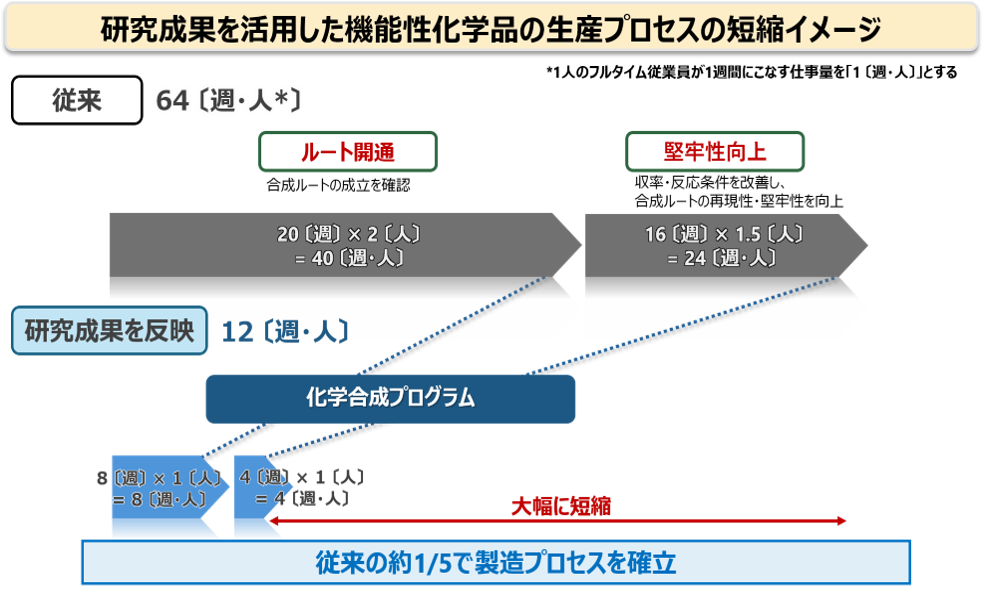
Furthermore, pharmaceuticals were manufactured within the Project using synthesis routes proposed by the Program. The results confirmed that development time could be reduced to approximately one-fifth of that required by conventional methods*3, demonstrating the Program’s contribution to this substantial reduction.
2. Future Outlook
Transition State Technology will begin providing services using the Program on Wednesday, September 30, 2026. Through these services, the company will contribute to shorter development times, lower production costs, and the creation of new synthesis routes for functional chemicals, including pharmaceuticals, agrochemicals, fragrances, and electronic materials.
NEDO will also promote the practical adoption of the Project’s overall results to improve the efficiency of chemical processes and conserve energy, contributing to the achievement of carbon neutrality by 2050.
*1 The Project
Project name: Development of Continuous Precision Production Process Technologies for Functional Chemicals
Project period: Fiscal years 2019–2025
Project overview: Development of Continuous Precision Production Process Technologies for Functional Chemicals — https://www.nedo.go.jp/activities/ZZJP_100152.html
*2 The Program — https://amaterus.ai
*3 Approximately one-fifth of the time required by conventional methods
In an evaluation of pharmaceutical synthesis studies, use of the Program was confirmed to reduce the required work from 64 person-weeks to 12 person-weeks.